Our Indigenous Heroes - They Also Served


On the 12th August 2014 a story titled ‘The tragedy of Thomas Bungelene: Aboriginal Seaman in the Victorian Navy’ was posted on the blog of Indigenous Histories by Philippa Scarlett.
Let me tell you the story and add some to it. Philippa states that she believes it lives in the Stolen Generation History not that of Australian Aboriginal Service in the Defence Forces.
I believe that this story does belong in our Defence Force history as he was a documented serving member of the Victorian Navy. I agree with Philippa, he definitely should be in the Annals of the Stolen Generation, but also here.
Her story as written:
THE TRAGEDY OF THOMAS BUNGELENE: ABORIGINAL SEAMAN IN THE VICTORIAN NAVY.
Posted on August 13, 2014 by Indigenous Histories
Damien (Yarning Crescent) has recently pointed out that Thomas Bungelene was an Aboriginal man who served on Her Majesty’s Colonial Steamer Victoria from 1861 to 1864.
Peter Gardner who has written extensively on Thomas Bungelene and his family from 1978, was the first to draw attention to Thomas Bungelene’s naval service. He elaborates on this in Gippsland massacres: the destruction of the Kurnai tribes 1800-1860 first published in 1983. and in more detail in Through Foreign Eyes 1988 in which a chapter is devoted to the Bungeleen family. Information about Thomas Bungelene from archival sources as well as a photograph showing him in uniform was published in 1993 in My Heart is Breaking, a guide to records about Aboriginal people in the Public Record Office of Victoria and the National Archives of Australia’s Victorian Office.
Thomas Bungelene or Marbunnun was the son of Gippsland Gunai, Kurnai leader Bungelene (Bunjil-ee-nee) who with his children was detained by the Native Police during the celebrated/notorious search for the ‘white woman’ in 1847. His father, who was brutally treated, died the following year in the Native Police barracks. Attempts were made to ‘civilise’ Thomas who was sent to the Merri Aboriginal School at the junction of Merri Creek and the Yarra and later worked in the Lands Survey Office. Subsequently Thomas came under the control of the Victorian Central Board Appointed to Watch Over the Interests of the Aborigines.
In 1861 the Board, as a disciplinary measure, arranged for him to become a member of the crew of the Victoria with the rank of ‘seaman’. He spent three years on this ship during which time the Victoria travelled to the Gulf of Carpentaria seeking to locate evidence relating to the disappearance of the explorers Bourke and Wills. His service was punitive not voluntary and although he sought to leave the ship he was in effect a virtual prisoner. Not only that but he was not paid.
Bungelene may have been the earliest known Aboriginal member of a colonial force – naval – as opposed to the men who later served in military units – but his service differed from that of these men. It was coerced: he was in the power of the Central Board and he received no remuneration. His service was part of an attempt to control and civilise and bore no relation to the service of the Indigenous men who followed him, who served of their own free will as volunteers.
He died the year after he left the navy on 3 January 1865, aged 18. The Board noting his death in its annual report for 1866 recorded his short, stolen life as a failure.
Thomas Bungelene, an Aboriginal, who for some months was employed in the [Board] office in Melbourne, and gave evidence of some talent, is dead. A hope was entertained at one time that he would become a useful member of society; but, whether owing to defects in his early education or a natural propensity to evil, he became nearly as troublesome in the office as he was when on board the Victoria. He died of gastric fever.
Thomas Bungelene undoubtedly served in the Victorian navy and undertook on oath to serve the Queen ‘on board of any armed vessel belonging to Her Majesty’s local government of Victoria’. However his tragic story lies more appropriately with the story of the stolen generations than it does with that of Aboriginal service in Australia’s armed forces.
Philippa Scarlett 13 August 2014
The Victorian Naval Forces Muster for the Colony of Victoria 1853-1910, give a profile of Thomas Bungalene aka Bungaleen, Bungeleen or Marbunnun, with the rank of Seaman, Birth date c1847, as crew of the HMCS Victoria.
1853 is given as the commencement date for the Victorian Navy as this is the year that Commander Lockyer (RN) went to Britian to superintend the building of HMCA Victoria. Although the Victorian Navy ended in 1901, the career of Cerberus continued. In 1910 the new ships started arriving and manning levels increased.
"Thomas Bungaleen was the son of a Gippsland headman whose family was brought to Melbourne by the Native Police in 1847. After his father’s death, the boy was placed in the Merri Creek Aboriginal School under the supervision of Assistant Protector of Aborigines William Thomas. Carol Cooper
"In 1860 the Victorian Board for the Protection of Aborigines (BPA) became interested in the 14 year old boy called Thomas Bungalene, who was working in the survey office. The BPA decided that he should be sent to St Kilda Grammar School in order that he would "receive a good education and become fitted for some profession". When the principal of St Kilda Grammar School refused to admit him, Scotch College was approached; again he was turned away. Bungalene was placed in the charge of a schoolmaster, Robert Doig, who was paid an annual fee to look after the boys education and board. After six months the arrangement faltered, and the board decided Bungalene should go to sea. He died only a few years later."Source: Taking Assimilation to Heart, Katherine Ellinghaus.
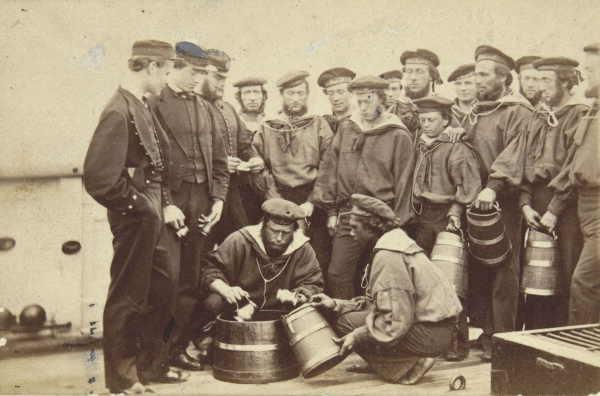
Thomas (squatting) & other crew members of HMCS Victoria receiving their rum ration ca 1861. Photo from the State Library of Victoria, Picture Collection.
"Thomas Bungaleen was the son of a Gippsland headman whose family was brought to Melbourne by the Native Police in 1847. After his father’s death, the boy was placed in the Merri Creek Aboriginal School under the supervision of Assistant Protector of Aborigines William Thomas. Carol Cooper
"In 1860 the Victorian Board for the Protection of Aborigines (BPA) became interested in the 14 year old boy called Thomas Bungalene, who was working in the survey office. The BPA decided that he should be sent to St Kilda Grammar School in order that he would "receive a good education and become fitted for some profession". When the principal of St Kilda Grammar School refused to admit him, Scotch College was approached; again he was turned away. Bungalene was placed in the charge of a schoolmaster, Robert Doig, who was paid an annual fee to look after the boys education and board. After six months the arrangement faltered, and the board decided Bungalene should go to sea. He died only a few years later." Taking Assimilation to Heart, Katherine Ellinghaus.
"In its first report, issued in 1861, the Board went so far as to express its hope that the boy Thomas Bungalene captured as an infant in 1847 by white raiding parties in search of the mysterious "white woman of Gippsland" and fostered by various officials of the Protectorate and Guardian ever since, might yet become a good citizen." White without Soap, Marguerita Stephens, 2003 Melbourne University
In 1861, Bungaleen was bonded to work on the steamship Victoria, where he won approval following a trip to the northern coast in search of the missing Burke and Wills Expedition. Bungaleen died in 1865 and was buried in the Melbourne Cemetery." Carol Cooper
"Thomas received no wages in the navy but was outfitted at the expense of the Board for the Protection of Aborigines." Victoria. A History of Her Majesty's Steam Sloop Victoria, Ian MacFarlane unpublished manuscript.
Thomas Bungeleen (an anglicised version of his father’s name, Bunjil-ee-nee) was "a lonely lad who spent his life among alien people" (Barwick and Barwick, 1984: 9). He was kidnapped from his tribe in 1847 by Police officers and taken to Melbourne with his father (a ngurungaeta of the Waiung clan, of the Brabralung group of the Kurnai of Gippsland), mother, brother and other family members.
Thomas was two years old at the time and his brother, Harry, aged six months. His father died at the Narre Narre Warren Native police barracks. Thomas' mother died 3 years later, and in 1851, he and his brother were placed with a Melbourne schoolteacher and taught European habits. They were publicly baptised. Harry died in 1856, and Thomas, now aged 11, was said to have become increasingly uncontrollable.
He was made a messenger for the lands department, and visited Simon Wonga (ngurrungaeta (clan head) of the Wundjeri-balak clan of the Woiworung of the Kulin) on several occasions. However, Thomas was said to be "getting into bad company" after hours (Barwick & Barwick, 1984: 10), and in 1861 was bonded to service on a steamship.
Thomas was bitterly unhappy and asked to be sent to live with Simon Wonga and his people. His request was refused and he continued to serve on the steamship until 1864, when he was sent to train as a draftsman. Thomas Bungaleen died in January 1865 of gastric fever, aged 18 years. He was buried with his brother in the Melbourne cemetery. Simon Wonga made a wood carving in memory of Thomas Bungeleen.
The story told in the carving was summarised later by surviving Yarra people as:
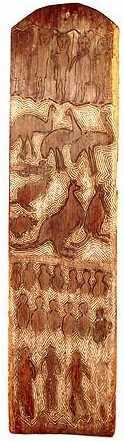
...the men represented in the upper part ...are friends who have been appointed to investigate the death of Bungeleen; the figures of the birds and animals....indicate that he did not die for lack of food; and the strange.....forms below the hollow band are those of Mooroops, or spirits who have caused the death of the Koori by their wicked enchantments (Barwick & Barwick, 1984: 9). [It is thought the Mooroops referred to here are the lohan (white men).]
The Mental Health of Indigenous Peoples, editors - Laurence J. Kirmayer, Mary Ellen Macdonald & Gregory M. Brass.
Transcription from the Ballarat Star 4th February 1865
‘The death of Thomas Bungalene forms a melancholy addendum to the lately issued fourth annual report of the Central Board appointed to watch over the interests of the Aborigines of Victoria, in which document it is intimated that “every care will be taken to teach him useful knowledge and to qualify him for a higher position that has yet been attained”
Thomas Bungalene, whose death from gastric fever took place on 3rd January was the son of Bungalene, the celebrated chief of Gipps Land, who with his wives and children were taken into captivity in 1845, as hostages for the production of a white woman whom the old warrior was supposes to have abducted. Bungalene was brutally chained to a gum-tree for many days and nights and otherwise ill-treated, and though afterwards meeting with greater consideration, soon died of grief.
His younger wife deserted her two infants, and they were removed in 1846 to Port Phillip. In 1848 they were placed in the mission station at Merri Merri Creek; and on the breaking up of that establishment in 1850, admitted, with consent of Government, to the National School, Moonee Ponds.
In 1852 they were publicly baptised at Trinity Church, Pentridge, but the death of his brother in 1856 left Thomas Bungalene the last of his line. In 1860 the board took his case into consideration – he then being employed in the Crown Lands Office. Some attempts had been made to teach him drawing, and he occasionally employed in copying letters and in other clerical duties ; but all those who took an interest in his welfare, and endeavoured to teach him, concurred in stating that his want of application rendered any great improvement quite hopeless.
He was found to be averse to labor, and all those inducements which operate on the European, were wanting in him. He had acquired a respectable knowledge of reading and writing, and had even mastered a little arithmetic. Further, he exhibited a quiet unembarrassed manner, and replied to every question calmly but promptly.
Here an opportunity seemed to be presented to the board of proving to the world that aborigines of Australia are degraded rather by their habits than in consequence of the want of mental capacity, and though the boy showed only an average ability, it was thought that by careful education and instruction, he would probably become a good citizen, and of the highest usefulness as an agent in dealing with his race.
With this in view, the board sought admission for him at the Grammar School, St Kilda Road. This was refused, and a proposal to have him educated at the Scotch College was abandoned on the recommendation of Dr Cairns, at whose suggestion he was placed under the care of Mr Robert Doig, a schoolmaster, who took charge of him at once.
It was found that the ordinary means of coercion were quite ineffectual to compel habits of obedience and industry, and under the eye of Commander Norman, of the Victoria war sloop, it was hoped that he might be taught the duties of a seaman. While on board that vessel he was noted for his habits of industry and sobriety ; but circumstances made it desirable that he should be removed, and in September last the Minister of Mines found him employment as a draughtsman.
While thus engaged, and having a few weeks previously joined the society of Oddfellows, his sudden death in his eighteenth year occurred.
Thus has been frustrated an experiment of the board which at one time was surrounded with a good deal that was hopeful. It had been found latterly that Bungalene wrote very well, was generally attentive to instructions, and was making fair progress in learning. He was gradually gaining a knowledge of mathematical instruments, could plot from a simple field-book and draw tolerably well. He appeared to when younger, his temper retained its half-savage peculiarities. But habits of perfect obedience seemed to be quite forgotten to his nature, and without them, little advancement was expected.
Well poor Thomas was not given a chance to even consider following his cultural instincts, instead constantly being moulded to the way of the white man. Such a sad story and to lose a lad so young, especially being the last in his line.
(courtesy of the National Library of Australia)
Sources:
Indigenous Histories by Philippa Scarlett
Friends of the Cerberus
National Library of Australia
Australian War Memorial
University of Newcastle
SBS Australia
Parliament of Victoria
ANU
Defence Reserves Association Newsletter April 2022
Mapping Australian History and Culture – TLCmap.org