Our Indigenous Heroes - They Also Served


Fighting for Country - 05 November 2020. By Claire Hunter with Isabella Walker.
Warning: this article contains images of deceased persons. It also contains racist terms and descriptions, the use of which reflects language and attitudes of the time.
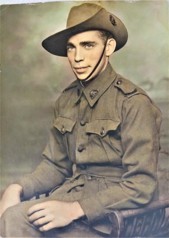
Clarence Atkinson DCM. Photo: Courtesy Isabella Walker
It was a day that would change Clarence Atkinson’s life forever: the 27th of June 1941.
The then 26-year-old was serving as a private with the 2/3rd Battalion in Syria when he made a split-second decision to charge an enemy machine-gun during fighting near Damascus.
The men of 10 Platoon had been pinned down by enemy fire from a Hotchkiss gun for three hours while attempting to hold a defensive position on the Jebel Mazar feature. One section of 12 Platoon tried to outflank the gun, despite the number of snipers, but was held up.
When the man next to him was shot in the head, Atkinson leapt into action. Armed with a haversack of grenades, he dashed forward among the rocks while coming under intense enemy fire. Pushing forward, he hurled the grenades, clearing the area of enemy and capturing the Hotchkiss gun.
He was awarded the Distinguished Conduct Medal for his actions that day, the first known Indigenous Australian to be awarded the medal during the Second World War.
He was praised for his “amazing courage … conspicuous gallantry and devotion to duty”.
A newspaper report from the time quoted another soldier as saying, “Darky Atkinson got a DCM for throwing the enemy a bagful of bombs”.
Five years later, he was homeless.
The third child of Cecil Atkinson and his wife Eileen, an Indigenous woman, Clarence Cecil Atkinson was born in the mist of the First World War in the Sydney suburb of Kogarah, New South Wales, on 21 May 1915.
He was working as a chef when the Second World War broke out in September 1939, and enlisted shortly afterwards, leaving behind his wife Clarice and their two young children, Gwendoline and Robert.
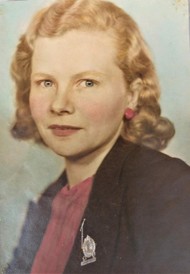
Clarence's wife Clarice Atkinson. Photo: Courtesy Isabella Walker
His uncle, James Atkinson, had served during the First World War and three of his brothers – James, William and John – would serve alongside him during the Second World War.
He was posted to the 2/3rd Battalion and sailed for Egypt in January 1940, arriving in Kantara on Valentine’s Day.
The battalion took part in successful attacks at Bardia and Tobruk in January 1941 and headed for Greece a few months later to resist the anticipated German invasion. In April 1941, they took part in the battle of Tempe Gorge, and helped block German movement through the gorge, allowing the unhindered withdrawal of Allied forces further south. By the end of the month, they were evacuated by sea and returned to Palestine. In June and July 1941, the 2nd/3rd took part in the campaign in Syria and Lebanon and fought around Damascus in the unsuccessful attempt to secure Jebel Mazar and in the climactic battle of Damour. The battalion returned to Australia in August 1942.
Atkinson struggled when the battalion left the Middle East and faced a long list of disciplinary infringements, including three court-martials. He was often absent without leave, and in October 1943, couldn’t be found. When he reappeared with his unit in early 1944, he was court-martialled and initially sentenced to nine month’s detention.
When he was released in mid-1944, he joined the 2/14th Battalion. He was promoted to corporal in January 1945 and went on to serve at Morotai and Balikpapan.
He returned to Australia after the war, taking on a number of different jobs, working at a tip, as a concreter, and even as a bookmaker from the front room of his house, in an effort to support his young family. His wife Clarice would work in a factory when he was between jobs to help out, but it still wasn’t enough.
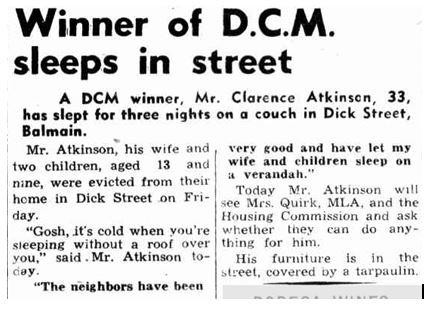
The Sun (Sydney, New South Wales), Monday 11 April 1949.
By 1949, they were homeless. Under the headline, Winner of DCM sleeps in street, the Sun newspaper reported that Atkinson and his family had been evicted from their home in Balmain.
His wife, and two children, aged 13 and nine, were sleeping on a neighbour’s veranda, their furniture in the street, covered by a tarpaulin.
“Gosh, it’s cold when you’re sleeping without a roof over you,” Atkinson was quoted as saying. “The neighbours have been very good and have let my wife and children sleep on a verandah.”
After speaking with an MLA and the Housing Commission, Atkinson and his family were moved to a flat at Herne Bay. Now known as Riverwood, Herne Bay was a housing settlement of timber huts initially built to accommodate casualties during the war. They were converted into Housing Commission flats after the war to help ease the housing shortage. Each hut could house up to three families, and the bathroom was a tin building behind the flat.
Atkinson and his family were eventually moved to a permanent residence in Charles Street, Riverwood, where they lived for almost 30 years.
He remained happily married for the rest of his life and had the privilege of watching his children and grandchildren grow.
His family said he died on 22 November 1981, having led a life that was more eventful and courageous than most. One thing he never spoke a word about was the war.