Our Indigenous Heroes - They Also Served

Published 28 July 2023 11:07am, By Madison Howarth. Source: NITV
The Korean War ended 70 years ago. The stories of Indigenous soldiers who served are finally being told.
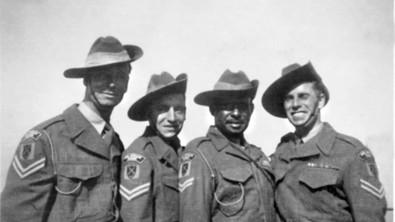
Torres Strait Islander man, Charles Mene (third from left), served in the Defence Force for 30 years including World War II and the Korean War. Credit: Australian War Memorial
On 27 July 1953, the Korean War ended. Now, exactly 70 years later, more than 60 Indigenous soldiers are being officially recognised by the Australian War Memorial for their service during the 'Forgotten War'.
The Australian War Memorial has identified more than 60 Indigenous men who served for Australia during the Korean War, 70 years after the Korean Armistice Agreement. These men were fighting for more than their country, fighting to be recognized. Captain Reg Saunders, a prominent Indigenous figure, commanded a Company of the 3rd Battalion, the Royal Australian Regiment, in the Battle of Kapyong.
The research also includes Torres Strait Islander Corporal Charles Mene, who received the Military Medal for his actions in 1952, and Albert Clothier, who was Mentioned in Despatches for his efficiency and devotion in Korea. The Australian War Memorial acknowledges the traditional custodians of country throughout Australia and pays respect to elders past and present.
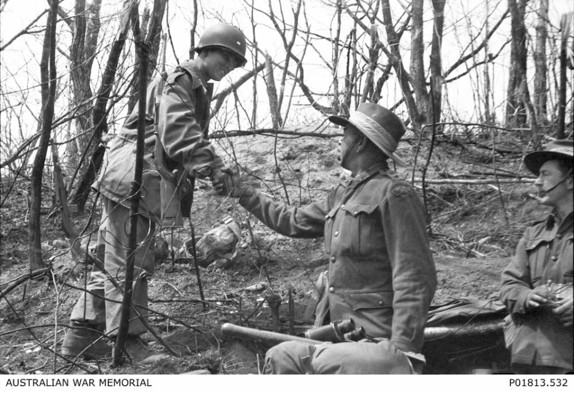
Captain Reg Saunders (right), commander of C Company, 3rd Battalion, The Royal Australian Regiment (3RAR), shakes hands with a Korean soldier. Captain Saunders was the first Aboriginal serviceman to command a rifle company. Photo: Australian War Memorial
Forgotten heroes: Indigenous servicemen of Korean War recognised after 70 years
Newstime Media - July 27, 2023
Seventy years ago today, the Korean Armistice Agreement was signed, ending the hostilities of the Korean War (1950–53). But many of the Indigenous men who served Australia in the conflict have been forgotten. Today, the Australian War Memorial announced that it had identified more than 60 Aboriginal and Torres Strait Islander servicemen.
“These men were fighting for more than their country, they were fighting to be recognised,” said Michael Bell, the Australian War Memorial’s Indigenous liaison officer, himself a Ngunnawal/Gomeroi man. He leads the research on contributions and service of Aboriginal and Torres Strait Islanders.
(Read more: “Putting an Indigenous face on the ANZAC legend”, 21 April 2022)
“It was a significant transition period for our people at home and their role in the defence forces overseas.”
Most of the newly discovered Indigenous men served with the army contingent; seven men served with the Royal Australian Navy; and one seaman (Patrick Daniel Syron) served in Korean waters with HMAS Condamine in 1952–53.
At least three Indigenous men died as a result of their service: Sergeant Stafford Kenny James Lenoy, a member of the 3rd Battalion, Royal Australian Regiment, killed at the Battle of Kapyong in 1951; Private Harry Iona, who served in the 1st Battalion, Royal Australian Regiment, and was killed in 1952; and Private Edward George “Tody” Hazel, also of the 3rd Battalion, who died in June 1953, a month before hostilities ceased.
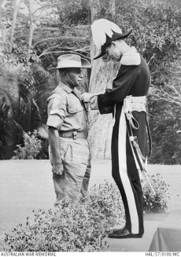
Charles Mene was a recipient of the Military Award for carrying wounded men to safety. Credit: Australian War Memorial
Two Indigenous men were officially recognised for conspicuous service. Torres Strait Islander Corporal Charles Mene received the Military Medal for bravery in 1952, when he carried wounded men to safety under heavy artillery and mortar fire. Sergeant Albert Clothier was Mentioned in Despatches for “efficiency, cheerfulness, and great devotion in Korea”.
Matt Anderson, the AWM’s director, said the research builds understanding and knowledge of Indigenous service in Korea and many other conflicts.
“This is part of the Memorial’s determination to ensure all who have served, suffered, and died in the defence of our freedoms are recognised.”
Australia became involved in the Korean War only five years after the end of the Second World War. The conflict began when North Korea (Kim Il-Sung’s Communist régime, backed by Soviet Russia) invaded the American-supported South Korea in 1950.
“The Korean War has long been described as the forgotten war,” said Michael Kelly, a Korean War expert and Australian War Memorial historian.
“Australian battalions fought several significant actions, including the battles of Kapyong and Maryang San, often against overwhelming odds.”
Kapyong (April 1951), the most famous and important battle fought by the Australian army in Korea, blocked the Chinese advance on Seoul. Here, Captain Reg Saunders, the first Aboriginal commissioned officer, commanded a company of the 3rd Battalion, the Royal Australian Regiment. Maryang San (October 1951) dislodged Chinese forces from strategically important hills; although official historians considered this “probably the greatest single feat of the Australian army during the Korean War”, the Chinese later recaptured the site.
More than 17,000 Australians served during the Korean War, 340 of whom were killed, and 1,216 wounded; 30 became prisoners of war. The armistice, which continues today, was signed at 10 am on 27 July 1953. “The Korean Armistice Agreement 70 years ago was a time in the world’s history when the United Nations was truly able to have an impact,” Mr Kelly said