Our Indigenous Heroes - They Also Served

From a lonely grave with the wrong name to being honoured by the nation
WARNING: Aboriginal and Torres Strait Islander readers are advised that this article contains images and names of people who have died.
Eighty years ago, a soldier was buried in a war grave with the wrong name. His real name was written out of history more than a century ago. Now, after a chance encounter, and a lucky find at a rubbish tip, his true identity has been revealed and his service is finally being recognised.
By James Vyver for the Indigenous Affairs Team
Charlie Bob Ngarkwokka.
Charlie Bob.
Charlie Bob Ngakyunkwokka.
Three names used for one man.
A Wanum man from the Wik nation in Cape York who, without his family knowing, lay buried nearby in a grave bearing the wrong name.
How this happened is a story that twists and winds like the rivers flowing through the Wik nation.
It’s a story that faded as the days passed by until all those who had known Charlie Bob were put to rest in graves of their own.
But in Wik culture, there has been no rest for the man buried without his name.
Wik Mungkan language names don’t just identify a person, they also describe where a person is from and who they are. “Surnames have the meaning of everything, their totems and their lands,” said Ariana Yunkaporta, a Wik Apalech woman from Aurukun, and Charlie Bob’s great-great-niece. “My language [first] name is Aimooch, that means the Rainbow Serpent, from Kendall River.
“My surname is Yunkaporta, Yunk is the leg of the brolga bird. “So that’s why it’s important that we need the right surname.”
Charlie Bob has had three different surnames.
Only one of these three surnames is correct, but it’s taken more than a century for him to be called by it.
Charlie Bob was born in 1912 at what was then the Presbyterian mission settlement in Aurukun, in Far North Queensland. Mission life was difficult for those who lived there — food, medicine and equality were all in short supply.
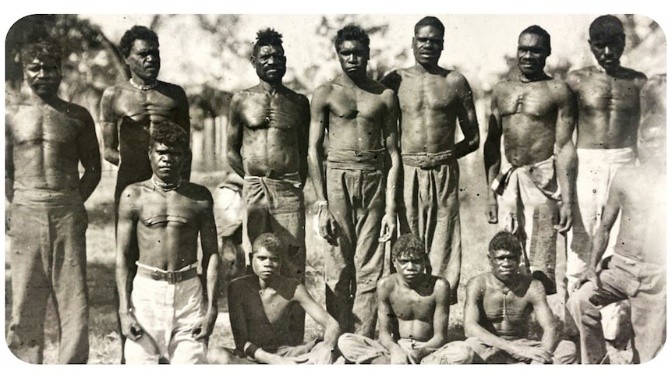
Men with initiation scars at the Aurukun Mission in 1913. (Supplied: State Library of Queensland )
“I sit with my old people and they tell me those stories,” Ariana said. “[They] used to work for them in outstations, like cattle stuff, and there was an old sawmill there. “They worked for rations, not for money.”
Information about the mission’s residents was limited to a few notes on an index card.
Like Charlie Bob, Aboriginal children born on the mission were given Western names along with their Indigenous names.
Charlie Bob’s card notes that he married a widow named Koppa (in late 1937 or early 1938) and that she died in 1944. They did not have any children. On his index card, the mission recorded Charlie Bob’s surname as Ngarkwokka. But Ngarkwokka is a name that does not exist in Wik Mungkan language. It should have read Charlie Bob Ngakyunkwokka — his correct full name. His Wik family members would have known and used this name. They would have known his totem was the galah, and that the Ngak part of his name meant chest. But Ngakyunkwokka would not be used in Western records for well over 100 years.
He enlisted for service with the Australian Army on 13 September 1943, joining the 2nd Australian Water Transport Group, before being transferred to the 14th Australian Water Transport Operating Company and piloting small vessels in the Torres Strait and the Gulf of Carpentaria to transfer fuel, munitions and troops. The work was risky, with boat crews facing the threat of Japanese air attacks from above and concealed sea mines from below. Charlie Bob had signed up to protect a nation that did not recognise him as a citizen, which was reflected in his pay packet.
First Nations soldiers were paid a third, then later two-thirds of the amount that white soldiers were paid. In March 1945, Charlie Bob’s water transport unit became part of the Torres Strait Light Infantry Battalion. This battalion was unique in the Australian Army because all enlisted soldiers were Indigenous. “I thought that only white Australians served in the world war,” said Ariana, who has only just learned about her ancestor’s service. In April 1945, just a few months before the war ended, Charlie Bob died while on leave in Aurukun. The mission card and his military record indicate his cause of death was influenza.
Charlie Bob was buried in the mission cemetery in Aurukun. Like so many casualties of the war, his story was buried with him. Families around the world often found it difficult to talk about their lost loved ones. “I think telling the story [was] probably very emotional for them … he was a family member who was loved by everyone,” Ariana said. But unlike other families’ war stories, there is a further cultural dimension to Charlie Bob’s. Ariana says in Wik culture, everyone in the community is considered to be a family member, whether they are directly related or not.
“Everyone is sacred, everyone loves each other,” she said. “We have that strong bond that no one can break. “Because we have that strong connection and strong love, when someone passes away, it affects us all.”
Death is dealt with differently in Wik culture compared with Western funeral practices.
Sorry Business protocols govern how the community mourns a person who has died.
In January this year, a local man is thought to have been taken by a crocodile. Months later, the town remains in Sorry Business. Certain areas around Aurukun are cordoned off by pink tape, including seating areas, as well as the riverbank area where the man was last seen.
“It means that the deceased person has sat on that chair, or sat at that location,” said Phylis Yunkaporta, the sister of the man who died, and Ariana’s auntie. “Once a pink tape is tagged in a certain area around community, family stay away.”
It is believed that if loved ones visit these areas, the spirit of the deceased will want to stay in the community, instead of passing to the afterlife. During Sorry Business the person who has died is not verbally referred to by their first name. Again, this is to allow the spirit to pass on.
Instead, the deceased is referred to as “Waal Waal”, until Sorry Business has ended — a period that can last for up to a year. Anyone who has the same name, or a similar name, to the person who died is referred to as Thaapich until Sorry Business ends.
As Charlie Bob died while on active duty, he was entitled to a Commonwealth War Grave.
In the 1950s, a war grave with a white marble headstone was dedicated to him in the Aurukun cemetery. But there was another problem. The headstone, still there today, refers to Charlie Bob as Private Ngarkwokka. Not only is the surname incorrect, but there’s also no first name at all.
His age is also wrong. Charlie Bob was 33 when he died, not 37. In 1963, Charlie Bob’s name, or a version of it, was also added to the Roll of Honour at the Australian War Memorial in Canberra, as one of 40,000 who served and died in World War II. First installed from 1961, the memorial’s brass panels contain more than 103,000 names of Australian servicemen and women who have died across all conflicts.
Placed in the section for the Torres Strait Light Infantry Battalion, his plaque reads: Ngarkwokka C. In this iteration of his name, the “C” for Charlie is there, but the “B” for Bob is missing, and the surname is still incorrect.
In the 1970s, a review by the Central Army Records Office looked at tens of thousands of records, searching for errors and additions to the roll. “[It was] recast in 1976, based off the service record,” said Lauren Watkins, Roll of Honour curator at the Australian War Memorial.
Ngarkwokka C was “corrected” to Bob C, matching the name Charlie Bob on the army documents. “His name was updated with the information available,” Ms Watkins said.
“But it was still incorrect.” There is no indication in the records of whether or not the bureaucracy contacted anyone in Aurukun to check the name. But there’s more to these errors than mere typos or incorrect records.
In the old mission cemetery where Charlie Bob is buried there are dozens of white wooden crosses bearing Aboriginal names. A flock of galahs — Charlie Bob’s totem — scratches around in the grass that surrounds the graves. Aurukun is a place where Christianity and Aboriginality have been forced together and melded. When the cross or headstone is dedicated to the lost loved one, Sorry Business typically comes to an end.
Charlie Bob was buried in accordance with the rites of Western Christianity, but the wrong name on his headstone means the Wik part of the ritual is incomplete. Strictly speaking, according to Wik culture, the Sorry Business for Charlie Bob’s death continues today, 80 years after he died.
Ariana’s brother, Irwin, completed the Kapani Warrior Program and went on to join the Far North Queensland Regiment, as an army reservist.
Ariana followed in her brother’s footsteps and both are now reservists in the regiment — the modern-day equivalent of Charlie Bob’s Torres Strait Light Infantry Battalion.
“We thought we were the first in the family to serve in the army, but we didn’t know our great-great-uncle served in World War II,” Ariana said.
How they discovered the family link was a matter of coincidence. In 2022, Tim visited the old mission cemetery while researching the town’s history. He spotted a bright marble headstone glinting among the wooden crosses at the far end of the cemetery. It was Charlie Bob’s Commonwealth War Grave. “I’m a returned serviceman — I know what a war grave looks like,” Tim said.
But the name, “Ngarkwokka” wasn’t familiar to him. “I’ve sat around a lot of campfires in Aurukun and listened to stories and never had that name come up. “But I was thinking Ngarkwokka was pretty damn close to Ngakyunkwokka.” Unlike any of the government agencies that had come before, Tim had one piece of evidence that no one had seen.
The old mission building had burned down decades ago, but a crucial relic remained.
A metal plaque commemorating a list of World War II soldiers from Aurukun had survived the blaze, and was found by a council worker at the town’s tip.
Charlie Bob's service number matches with other records. (Supplied: Tim White)
Among the list of names on the plaque was Charlie Bob Ngakyunkwokka of the Torres Strait Light Infantry Battalion. It was the key to the whole puzzle.
“Ngakyunkwokka was born on the same day as Ngarkwokka,” Tim said.
“He also died on the same day, so we were pretty convinced that Ngarkwokka was actually Ngakyunkwokka.” Tim’s close relationship with the Yunkaporta family meant he knew descendants of the Ngakyunkwokkas.
“They told me stories about him, that he served in the world war, and that he had a brother,” she said. Since then, Ariana has conducted her own research by speaking to family members who still remember that generation. They discovered Charlie Bob’s brother, Bob Massey Ngakyunkwokka, is buried next to him.
Ariana is now considering joining the army full-time, inspired by her great-great-uncle.
After three years of careful research and consultation with Charlie Bob’s family, the Australian War Memorial has now updated, and accurately corrected, the Roll of Honour.
“Ngakyunkwokka C.B.” was added to a supplementary panel in May.
Charlie Bob is the only person who appears on the Roll of Honour three times, as the incorrect versions of his name remain along with the correct one. “This is about setting the record straight, making sure that every name we have on the Roll of Honour is accurate,” said Matt Anderson, director of the Australian War Memorial. ″This is the nation’s debt recorded in bronze, and if we can get it right, that’s what we’re determined to do,” he said. In May, Ariana and her brother Irwin were invited to a Last Post Ceremony dedicated to their great-great-uncle, and the correcting of his name on the official roll. They laid a wreath to honour Charlie Bob’s service, as did memorial staff.
Despite being about 3,000 kilometres from Wik country, Ariana said she and Irwin felt closer than ever to their new-found relative as he was honoured in Canberra last week. More than a century after his birth, and 80 years after this death, Ariana and Irwin placed poppies by Charlie Bob’s name on the Roll of Honour. “It’s a very, very powerful statement by our young soldiers,” Mr Anderson said. “But it’s also a powerful expression of the honour that they have in following in his footsteps.” Visitors, including serving personnel, watched the ceremony from the cloisters.
The ceremony ends with: “At the going down of the sun and in the morning, we will remember them.” Ariana said she felt a mix of emotions during the ceremony, but the deepest was pride.
“Because he’s not just a role model to us, he’s a role model to Aurukun as well, the whole community, and the whole country.”
Credits