Our Indigenous Heroes - They Also Served

What ANZAC means for young generation of Navy personnel
On the eve of the ANZAC centenary, Jarryd Boyd, a 25-year-old Biripi man and combat systems operator, reflects on the pride and opportunity he attributes to the Royal Australian Navy.
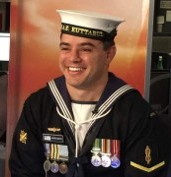
Able Seaman Jarryd Boyd, Royal Australian Navy. (NITV)
A century on from the first landings at Anzac Cove, Gallipoli, the vast scale of the country's commemorations demonstrate just how strongly those tragic events remain seared to the nation's consciousness. But what does ANZAC Day mean to young servicemen and women of this generation, today?
"Pride," says Able Seaman Jarryd Boyd, a 25-year-old Biripi man from Bulahdelah in NSW, who is currently serving in his sixth year as a combat systems operator with the Royal Australian Navy.
"I love my country so I love putting on the uniform. I'm proud of my heritage and it’s a job I love doing."
Boyd is the third man from his family to enlist in the Australian Navy.
"My grandfather was in the Navy … and I had cousins in the Army – about five of them. So ANZAC Day was always a very special day."
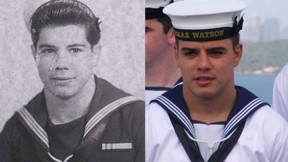
Jarryd Boyd (right) and his grandfather, Patrick Syron (left).
Boyd's grandfather, Patrick Syron, fought in the Korean War. On ANZAC Day, along with his own medals, Boyd wears those that belonged to his grandfather.
"It's an honour for me to march with my mates and march in honour of him and wear his medals; it's a massive honour."
Opportunities on board
Boyd, who has spent seven months at sea, says that the discipline of the navy changed his life. He hopes that the service can support and employ more young Indigenous Australians.
"There's so much available for Indigenous people in the military but I don’t think that it is exposed enough for Indigenous people to know," he said.
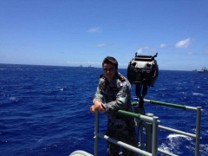
Off the coast of Hawaii.
"We see Navy ads on TV and all that, but remote communities don't all have TV, so the message doesn't really get there as much."
"The Navy has a massive focus on… just getting on board with anything Indigenous," Boyd said.
"I've been in the Navy AFL for five, six years, and this year has been the first time that there has been an all Indigenous side. There was heavy backing from Defence for that."
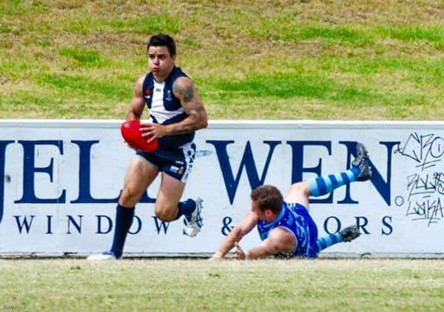
Navy AFL champions.
The Australian Defence Force offers a cadetship program for Indigenous Australians, and the Defence Indigenous Development Program that provides literacy, military and leadership
training, and cultural appreciation.
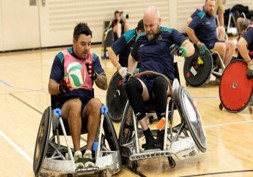
Biripi Navy veteran Jarryd Boyd (left) has found a new purpose through the Invictus Games. (Image: ADF)
Proud Biripi man and Petty Officer Jarryd Boyd, a physical training instructor with the Royal Australian Navy, has faced significant physical and mental challenges following a series of injuries.
However, a series of debilitating injuries has tested his body and mental resilience, forcing him to identify new goals and redefine his approach to training and competition.
The 35-year-old has undergone multiple surgeries on his left ankle and right knee, leaving him with osteoarthritis. In addition, an accident at work resulted in the loss of sensation in his left arm and reduced grip strength. He is also carrying lower back injuries.
Collectively, these injuries have led to the downgrading of his medical classification within the Navy, meaning he no longer meets the criteria to serve at sea – something that, after nearly 16 years of service, has been a devastating blow.
“I think that for the better part of the last few years, I've really let my injuries be the excuse for a lot of things. It’s been a setback,” said Petty Officer Boyd, who lives in Erskine Park, NSW, with his wife Katie and children Scarlet (10), Leo (8), Zahlia (6) and Nyah (5).
“I now realise that the likelihood of me being fit again to go back to sea is really slim. That was a kick in the guts for me.
“When I saw the expression of interest come out for Invictus Games, I thought, what better way to use this as justification for why I could still be employed? That’s for me on a work level.
“On a personal level, being surrounded by good physios and doctors has also shown me a different side of the coin; that there’s no reason you still can’t be competitive in sport, whether it’s adaptive sport or a lower level than what you’ve done before. You just have to manage your body.”
'Being selected for Invictus has actually changed the way that I think a lot about things, and it’s given me a drive to be competitive again.'
As one would imagine of a person whose day-to-day work has centred on physical fitness, sport – AFL, rugby league, touch football and cricket – was an important part of Petty Officer Boyd’s life growing up in Drummoyne.
“Being selected for Invictus has actually changed the way that I think a lot about things, and it’s given me a drive to be competitive again,” he said.
Although he likened day one of the initial training camp to the first day of school (“it was a bit daunting”), he confided that the initial nervousness had faded, replaced by solid connections.
“In terms of bonding with everyone, it just gets stronger and stronger and stronger. Everyone is here to support each other,” Petty Officer Boyd said.
Speaking of support, the current facility manager at HMAS Penguin and operations manager for Navy AFL couldn’t be more effusive about the role his family played in his recovery. He is grateful his immediate family, together with his mother and parents-in-law, can all join him in Canada to watch him battle it out in alpine skiing, skeleton, wheelchair rugby, swimming and indoor rowing events.
While he is still awestruck that he is representing his country at an international sporting event, knowing he would be wearing the Australian kit – featuring a cultural connection to Australia’s First Nations peoples – makes the moment even more special.
As an Indigenous Australian, Petty Officer Boyd is deeply proud of his background and how it has helped to shape his identity.
“It’s something that I'm proud of and something I tell my kids to be proud of, too,” he said.
For this reason, he is looking forward to learning more about the indigenous peoples of Canada and their cultures – as the Invictus Games Foundation will partner with First Nations peoples within a host country for the first time.
The Invictus Games, an international adaptive sporting event for wounded, injured or ill military personnel, offers veterans and serving personnel the chance to reclaim their sense of pride, self-worth and determination through sport.
The Invictus Games, an international adaptive sporting event for wounded, injured, or ill military personnel, begins on February 8 in Vancouver and Whistler, offering participants an opportunity to rebuild pride and determination through sport.
Sources
Joseph Guenzler Published January 17, 2025 at 2.00pm (AWST) National Indigenous News
Australian Government Defence – 17 January 2025 - By Flying Officer Tina Langridge