Our Indigenous Heroes - They Also Served


This is the story of a young child rescued from the Atherton Tablelands in Queensland. His date of birth is believed to be around 1885. He had been born into a remote Aboriginal community, and there are two versions of how he came to be all alone. One is that his parents had been killed in inter-tribal warfare, the other that his people had been killed in a massacre during the Queensland frontier wars. Now it so happened that a Scottish scientist, Robert Grant, and his wife, Elizabeth, were on an expedition in the area, collecting specimens on behalf of the Australian Museum in Sydney. They took the child back to Lithgow in New South Wales and adopted him, giving him the name Douglas. He grew up there with the Grants’ biological son, Henry and eventually moved with the family to Sydney.
In primary school, Douglas was a willing student with interests in poetry (he particularly liked Shakespeare) and a talent for drawing. He won first prize in the Queen’s Diamond Jubilee exhibition in 1897 for a drawing of Queen Victoria. Amongst his other talents, he could speak in a broad Scottish accent and play the bagpipes!
He attended Scots College in Sydney and left when he gained an apprenticeship as a mechanical draughtsman at Mort’s Dock and Engineering Company, where he worked for 10 years before taking a job as a wool classer at “Belltrees” Station in the Hunter Valley.
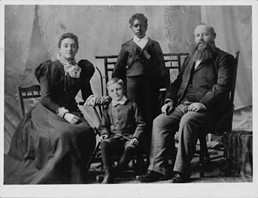
Douglas Grant with his adoptive family, c. 1896. National Archives of Australia, Canberra, SP1011/1, 2176. Reproduction courtesy of the National Archives of Australia and Australian Broadcasting Corporation Library Sales.
Douglas enlisted in the army in 1915. However, the Aborigines Protection Board intervened as he was about to leave Sydney for Gallipoli, citing Government regulations that prevented Aboriginal people from joining the military or leaving the country without permission, and so Douglas was discharged from the army.
However, being an intelligent and determined man, Douglas wasn’t going to let a bureaucratic technicality prevent him from serving his country, and he re-enlisted on 13 January 1916. Eventually, the authorities gave him permission to go on the basis that he had been raised by a white family. He left Australia in August 1916 and joined the 13th Battalion on the Western Front.
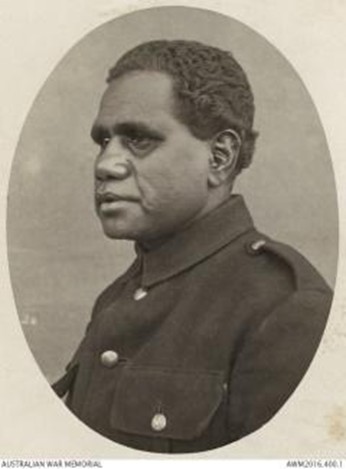
Douglas Grant as a prisoner of war in Germany, c. 1917–18. (AWM2016.400.1)
In April 1917, he was wounded at Bullecourt and taken prisoner. After spending time at other prisoner of war camps doing hard labouring work, he became an object of curiosity to the Germans because of his dark complexion, his history as an Aboriginal child brought up and educated in white society, and his ability to speak in a Scottish accent. He was sent to a camp at Wündsorf, near Berlin, where he was examined at some length (inside out, up and down, and everywhere in between, he used to say!)
He enjoyed unusual freedom as a captive. In Berlin, German anthropologists were more interested in studying him than in imprisoning him. A talented artist, he impressed his captors with his intellect. A German scientist described Grant as “an unmistakable figure,” recalling how prisoners appointed him to take charge of relief parcels because of “his honesty, his quick mind, and because he was so aggressively Australian”.
He was repatriated from Germany to England in December 1918, but before returning to Australia, he took the opportunity to visit the Grant family in Scotland. How surprised his Scottish uncle must have been to see a coal-black man standing before him, but he was welcomed and accepted by the family!
So how did this intelligent, well-educated man fare when he returned to Australia?
Douglas was discharged from the AIF on 9 July 1919 and received the British War Medal and the Victory Medal. However, the equality he had experienced in the AIF did not continue in Australian society. He was not entitled to the grants and benefits that other ex-servicemen could obtain.
Soldiers returning to Australia, including Private Douglas Grant (middle row, fourth from left), 1919
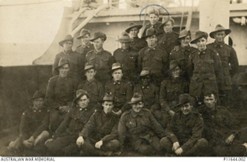
He returned to work at Mort’s Engineering Company, but after his adoptive parents died in the early 1920s, he returned to Lithgow and obtained work in a factory as a labourer. When he lost this job, he found it difficult to get another. He became active in fighting for Aboriginal rights and spoke out about the plight of Aboriginal people, especially ex-servicemen, which at that time would not have endeared him to the authorities.
Born Indigenous, raised and accepted in white society as a child, treated and respected as an equal in the army, an object of curiosity as a captive and for a time seen as a celebrity veteran, how could Douglas reconcile the stark contradictions in his life pre and post war, especially after the death of his parents? Although he had accepted white culture, it was clear that when he became an adult, the feeling was not reciprocated.
He did as many veterans did, coped by drinking heavily, and in 1931, suffering a mental breakdown, he was admitted as a patient to Callan Park Mental Asylum. He continued to live there and worked as a clerk for the next ten years; during this time, he also designed a large ornamental pond which was spanned by a replica of the Sydney Harbour Bridge. He was living at a war veterans’ home in La Perouse when he died in 1951, at the age of 66 years, a lonely and depressed man, unable to fit easily into either black or white society.
You can find a lot of information about Douglas Grant if you put his name into your favourite search engine. Chris Clark wrote an article which was published in the Australian Dictionary of Biography, Volume 9, 1983 and online in 2006. Macquarie University documentary maker Associate Professor Tom Murray featured his story in the documentary “The Skin of Others”, which debuted in the 2020 Sydney Film Festival, and the ABC Radio National programme “Earshot” broadcast his story in 2017. Other sources were research by Professor John Maynard for a University of Technology Sydney series of podcasts and videos, and an article by Nicole Cama for the Barani website (www.sydneybarani.com.au/sites/douglas-grant)
Phyllis Darragh – Snowy Valleys Heroes Inc
Sources:
“Aborigine enlists”, Queensland Times, 5 September 1916. <accessed 4 September 2019>
“Aboriginal soldiers: story of Douglas Grant”, Morning Bulletin, 9 September 1916. <accessed 4 September 2019>.
“Sergt. Douglas Grant: dark skin but white heart”, Lithgow Mercury, 28 April 1916. <accessed 14 October 2019>.
“An Aboriginal soldier”, Sydney Mail, 10 May 1916. <accessed 14 October 2019>.
Douglas Grant service papers, c. 1914–20, National Archives of Australia. <accessed 4 September 2019>.
Paul Daley, “From Butchers Creek to Berlin: did Douglas Grant see the body of an Indigenous relative in Germany?”, The Guardian, 16 October 2015. <accessed 4 September 2019>.
Tom Murray, “Douglas Grant and Rudolf Marcuse: wartime encounters at the edge of art”, Taylor and Francis Online, 13 May 2019. <accessed 4 September 2019>.
Tom Murray, “Douglas Grant: the skin of others”, ABC Radio National Earshot, 2017. <accessed 4 September 2019>.